When AI Writes Code Faster Than We Can Understand It
2026.08.15.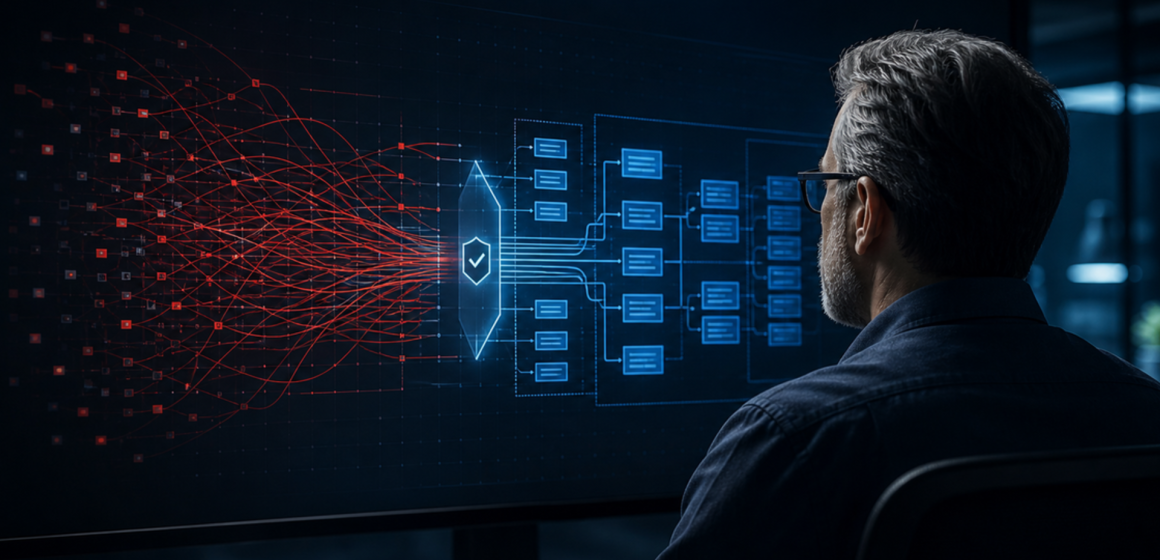
AI can significantly accelerate software development, but it does not guarantee high-quality software on its own. If nobody understands, reviews, and keeps the generated code within sound engineering boundaries, the initial speed can quickly turn into technical debt, security risks, and an unmaintainable system. At ForgeMVP, AI does not replace senior developers: experienced engineers guide and review every step of its work.
AI-powered development tools can produce code in seconds that would previously have taken hours to write. They can build features, identify bugs, generate tests, and even create the foundations of complete applications.
This can provide a serious competitive advantage—but only when genuine engineering control supports that speed.
AI can confidently produce solutions that appear to work at first but prove difficult to maintain, scale poorly, or conceal security issues over time.
The greatest risk is not AI, but the lack of oversight
The problem begins when the developer or project owner no longer fully understands what the AI has produced. The system may work, but nobody can say with confidence:
-
why a particular solution was chosen;
-
how its individual components interact;
-
which assumptions the code relies on;
-
what security or performance risks it contains;
-
what will happen when the system needs to be changed or expanded.
In such cases, AI can keep adding new layers of code on top of earlier solutions that were never properly reviewed. A workaround is generated to hide a minor issue, followed by more generated code to address the side effects of that workaround.
From the outside, the system may appear to be progressing. Internally, however, it becomes increasingly difficult to understand. The code can develop into an uncontrolled, tangled structure in which every modification causes new side effects, while the true source of each problem becomes harder to identify.
Working code is not necessarily good code
Software quality is not determined solely by whether the application runs at a particular moment.
A professional system must also be understandable, testable, secure, scalable, and maintainable over the long term. It must align with the business objectives, the chosen technologies, and the architecture of the entire system.
An AI-generated solution, by contrast, often sees only the immediate task described in the prompt. It may not understand the complete business context, future plans, or the previous decisions that determine how the product should evolve.
Without human oversight, this can lead to:
-
unnecessarily complex architecture;
-
duplicated or conflicting solutions;
-
outdated or unsuitable dependencies;
-
inadequate error handling and testing;
-
performance issues;
-
privacy and security vulnerabilities;
-
increasing technical debt;
-
progressively more expensive development.
The time saved at the beginning may later be consumed several times over by debugging and redesign.
AI needs technical leadership too
AI is a development tool. It is extremely powerful, but it is not an independent technical decision-maker.
Like any other tool, it needs precise requirements, appropriate constraints, and continuous review. Someone must determine what context it receives, what it may modify, which architectural principles it must follow, and how its output should be evaluated.
Writing prompts alone is not enough. Deep development and system design experience is required to identify solutions that appear convincing but are technically flawed.
An experienced engineer does not merely check whether generated code works. They also verify whether it:
-
solves the right problem;
-
fits the system’s architecture;
-
remains understandable and maintainable;
-
handles errors and edge cases correctly;
-
manages data securely;
-
can be validated through testing;
-
can be developed further at a sustainable cost.
At ForgeMVP, AI accelerates—the senior engineer decides
At ForgeMVP, we do not hand the entire development process over to AI without supervision. Our AI-assisted workflows are guided by senior developers with 10–20+ years of professional experience.
They define the system architecture, break the development process into appropriate tasks, review the generated code, and ensure that the result remains understandable to human developers.
AI-generated solutions go through the same professional controls as human-written code:
-
architectural review;
-
code review;
-
automated and manual testing;
-
security assessment;
-
performance checks;
-
documentation;
-
maintainability review.
This allows us to use AI’s speed to strengthen the work of experienced developers—not as a substitute for quality.
Faster, but not at the expense of the future
Speed to market is especially important when developing an MVP. However, moving quickly should not mean building foundations that start obstructing growth within a few months.
A well-designed MVP is not a disposable prototype. It is a deliberately constructed starting point from which a real product, a stable service, and a scalable business can grow.
ForgeMVP’s goal is therefore not simply to produce as much code as possible, as quickly as possible. We build software whose operation we understand, for which we can take professional responsibility, and which can be developed safely in the future.
AI represents an enormous opportunity in software development. Its true value emerges when experienced engineers turn that opportunity into a reliable product.
If you want to combine AI’s speed with senior engineering oversight, secure architecture, and maintainable code built for the long term, entrust your development to the ForgeMVP team.
Neked is van egy hasonló ötleted?
Meséld el, és 1 munkanapon belül konkrét ajánlatot kapsz rá.
 Csatlós Kata