HostGuard: A Complete Website Monitoring Platform Built by ForgeMVP
2026.08.08.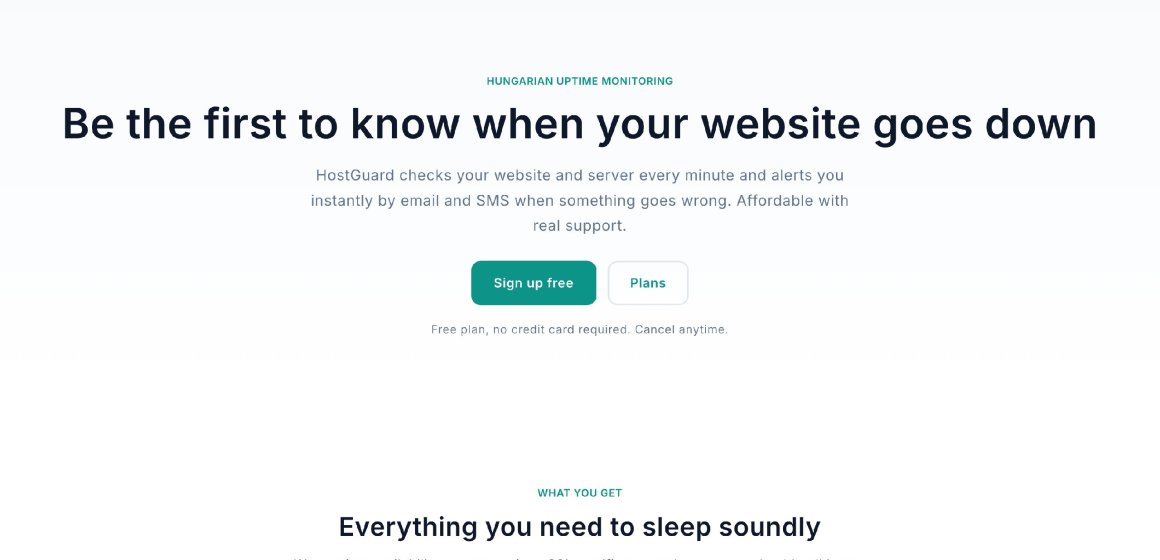
A website rarely announces its downtime in advance. Trouble usually surfaces when a customer calls to say the shop won't load, or when traffic starts sliding in search. HostGuard closes exactly that blind spot: it checks the state of websites and servers every minute and alerts you instantly when something breaks. The platform was designed and built by ForgeMVP, from the first sketch to a working product.
This case study shows the challenge HostGuard was built to solve, what ForgeMVP added to it, and the difference it made to day-to-day operations.
The Challenge: Someone Else Always Learns About the Outage First
For most businesses, website availability is a business question, not a technical luxury. An outage means lost orders, eroded trust, and slipping search rankings. The problem is that most operators only find out about it after the fact, from an outside signal.
HostGuard's client came with a specific need: an affordable uptime monitoring service, available in their own language, backed by real support, that looks beyond bare availability. The requirements were clear:
- The system should not only see that a page responds, but whether it responds with the right content.
- The downtime alert has to reach you even when you are not looking at your inbox, which means SMS is required, not just email.
- It must not generate noise: no needless alarms over one-off, transient glitches.
- Beyond plain website checks, it should see the internal state of the server and the related protocols too.
The international tools on the market are expensive, English-only, and often too complex for a small or mid-sized business. That is where ForgeMVP came in.
The Solution: What ForgeMVP Built
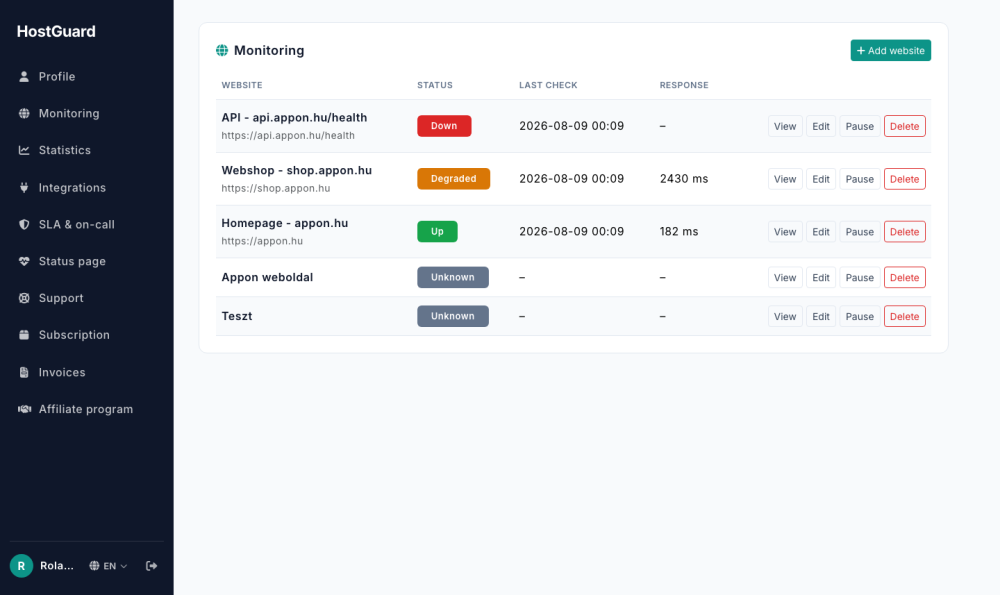
Monitor list with live statuses (up / slow / down) and response time
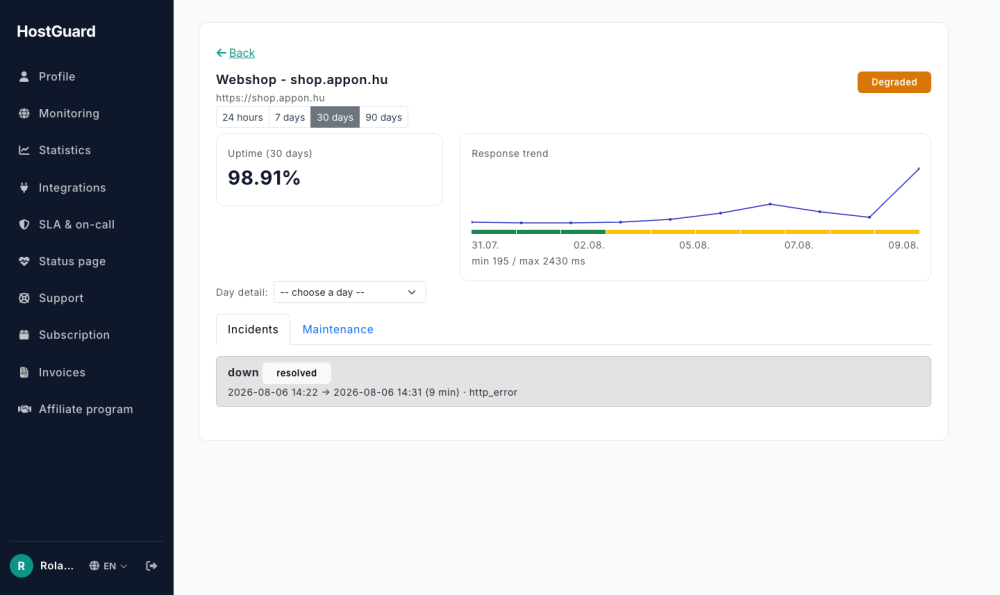
Alerting integrations: webhook, Slack, Discord, Telegram
ForgeMVP built a modular platform on PHP and PostgreSQL, in which every layer of monitoring runs as a separate, well-scoped service. The goal was for the user to get started in three steps (enter the address, set up the alert, and let the system handle the rest), while serious monitoring logic works behind the scenes.
Website Monitoring That Catches the Silent Failures
HostGuard fetches the monitored page on a schedule and inspects the HTTP(S) response status code. If the page is unreachable or returns an error code, it alerts immediately. On top of this, ForgeMVP added keyword monitoring: you can specify text that must appear (or must not appear) on the page. This catches the silent failures too, the cases where the server responds with a 200 code but the content is broken, empty, or compromised.
Every check measures response time, which you can track on a graph. Slowdowns are often the precursor to a full outage, so the system flags degraded, sluggish states separately, before the page actually goes down.
Downtime Alerts Without the Noise
ForgeMVP built in a two-step check (flap protection): before raising an alarm, the system verifies a second time, so transient one-off glitches never generate a needless alert. Notifications can go out by email and by SMS (the latter through simplesms.hu), and the system signals not only the failure but the recovery too. For critical cases, there is an SLA / on-call escalation chain: if the first alert goes unacknowledged, the system notifies the next person on call.
Server Monitoring and Multi-Protocol Checks
Beyond the website, HostGuard sees inside the server itself. ForgeMVP built an optional, lightweight PHP health agent that, once installed on the server, exposes disk, memory, and CPU load. On top of that, the platform monitors not only HTTP(S) but also TCP, ping, DNS, SMTP, and IMAP connections, so every layer from the mail server to DNS can be checked in one place. Cron and heartbeat monitoring watch whether scheduled background jobs run on time, and alert you if a run is missed.
Everything Else Peace of Mind Requires
ForgeMVP covered the full lifecycle: SSL expiry monitoring (alerts 30, 14, and 7 days before expiry), domain expiry monitoring, maintenance windows to exclude planned downtime, website health checks (PageSpeed, SEO, and HTML quality), plus integrations for webhooks, Slack, Telegram, and Discord. Executive communication is served by an automated monthly uptime PDF report and a public, branded status page. The entire interface and every notification are available in both Hungarian and English.
It is all held together by a flexible plan structure: the free entry tier starts with no credit card, while the larger plans offer more monitored domains, more frequent checks, and a bigger SMS allowance.
The Result: The Owner Is the First to Know About an Outage
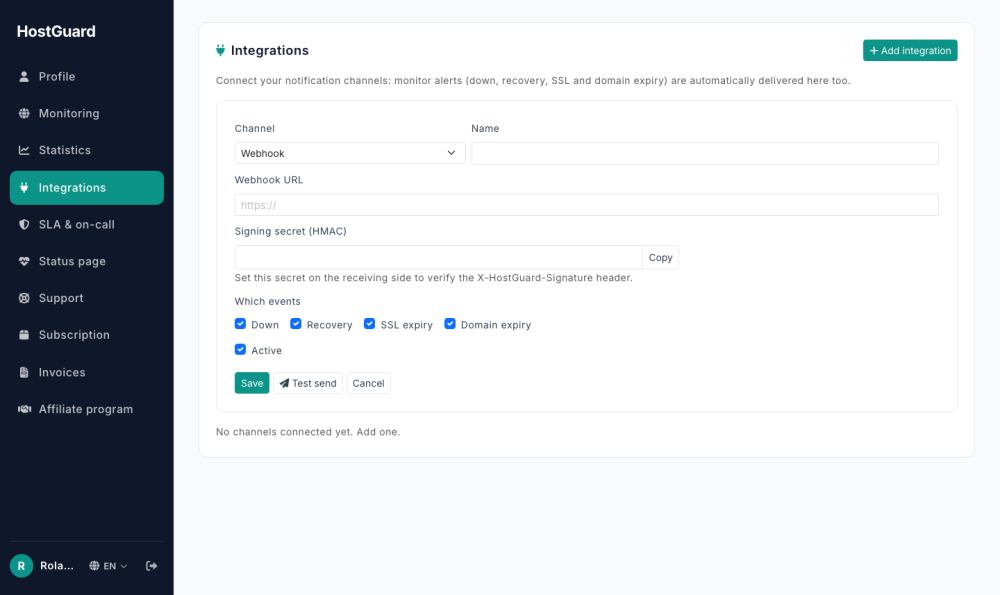
A monitor detail view: uptime and response-time trend, incidents
After HostGuard went live, the logic of operations flipped. Previously, failures came to light late, from an outside signal; with HostGuard, the system detects outages first, and the person responsible is notified instantly, by email and SMS, rather than through a customer complaint.
The qualitative impact shows up on several levels:
- Faster response. Minutes pass between the problem and the alert, not hours. Troubleshooting starts earlier.
- Less noise, more trust in the alarms. Because of flap protection, an incoming alert signals a real problem, so alert fatigue never sets in.
- Hidden failures surface too. Keyword and response-time monitoring catches cases that a plain availability check would let through.
- Peace of mind for the operator. The owner does not have to keep refreshing their site; HostGuard speaks up only when something is actually happening.
- Transparency toward customers. The public status page and the monthly report make the work done provable.
For ForgeMVP, HostGuard is a good example of how a complex SaaS handling several layers of monitoring can be delivered so that the end user gets started in three steps, with no installation.
Neked is van egy hasonló ötleted?
Meséld el, és 1 munkanapon belül konkrét ajánlatot kapsz rá.
 Csatlós Kata